
I've seen it a thousand times.
The candidate is brilliant. Top of their class, razor-sharp quant skills, aced every market sizing question I threw at them. They navigate a complex profitability case like a seasoned pro. They get the green light from the case interviewers.
Then they walk into the Bain values interview. The "fit" interview. The final hurdle. And they blow it.
They walk out feeling great. "It was just a conversation," they tell me. "We really connected." Two days later, the dreaded rejection email lands. They are stunned. They were so sure.
They fell for the trap. The single biggest trap in the entire MBB interview process.
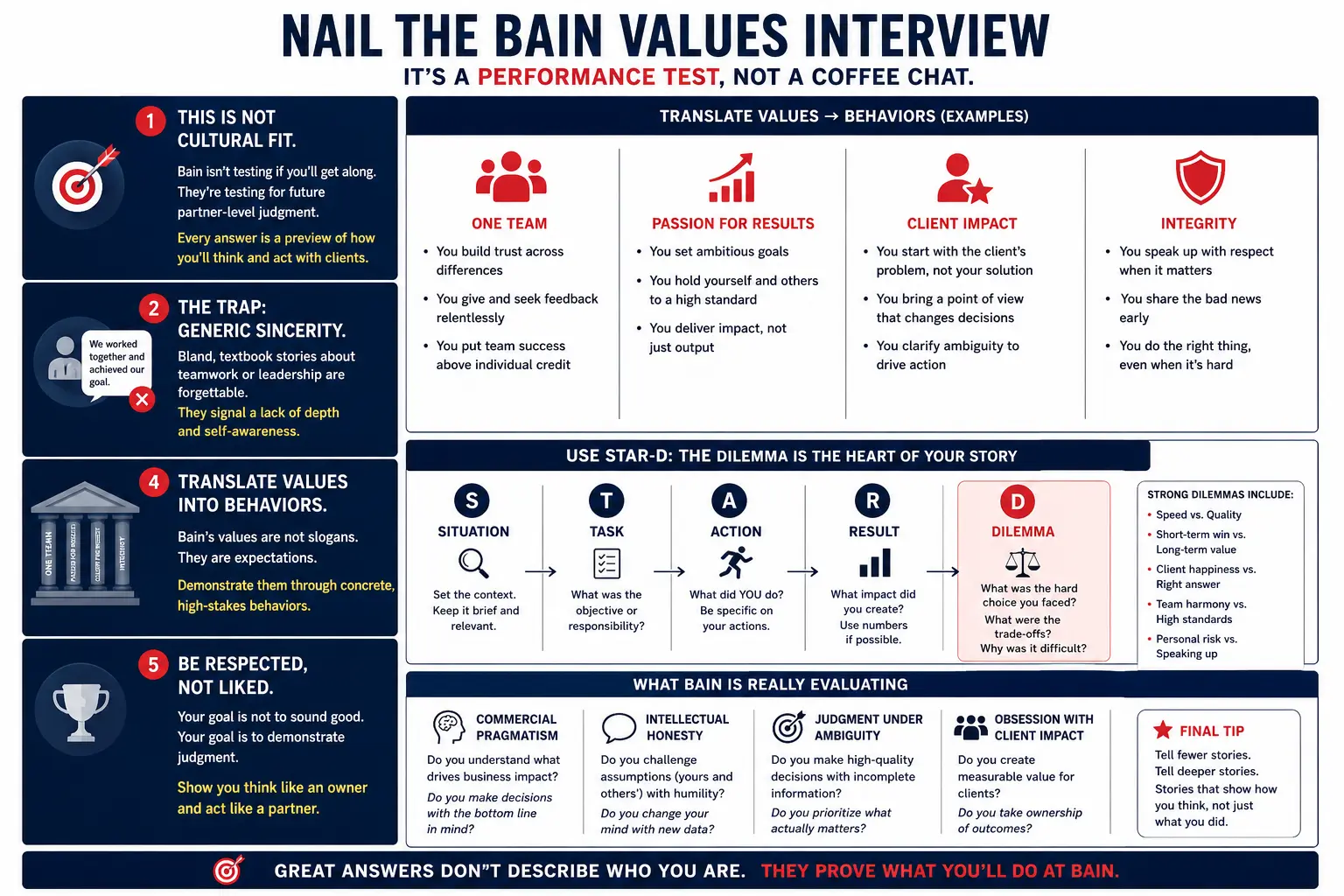
The trap is believing the Bain values interview is about checking if you're a "nice person" or a "cultural fit." It is not. It is the most critical data-gathering exercise of your interview day, disguised as a casual chat. And the currency they are looking for is not sincerity. It's judgment.
The Conventional Wisdom is Dangerous
Search online for "Bain fit interview," and you'll find a sea of dangerously generic advice:
- "Be authentic! Just be yourself."
- "Show you're a team player."
- "Talk about a time you showed leadership."
- "Make sure your values align with theirs."
This is the advice that leads 90% of candidates to give forgettable, textbook answers. "Being yourself" is useless advice if "yourself" hasn't been trained to articulate value in the language of a top-tier consultant. An interviewer doesn't care about your passion for rock climbing unless you can frame it as a story of calculated risk-taking and relentless execution.
When an interviewer asks, "Tell me about a time you worked in a team," they are not asking if you get along with others. They are asking: "Have you ever had to elevate a team's thinking, even when it meant creating friction? Have you ever had to subordinate your own ego for the good of the answer?"
Answering with a story about a college project that "went well because everyone contributed" is an instant red flag. It shows you've never operated in a high-stakes environment where intellectual disagreement is not just common, but necessary for excellence.
Deconstructing Bain's Values: What They *Actually* Mean
Let’s stop talking theory. Let's get brutally specific. Bain's values are public, but their interpretation inside the firm is not. Here's the translation you won't find in a brochure. Your job is to tell stories that prove you embody these *interpretations*.
Value: "A Passion for Results"
The Trap: Telling a story about winning. "We won the case competition." "I got the highest grade."
The Reality They Want: They want to see an obsessive, almost maniacal focus on client impact. It's not about your personal win; it's about the tangible, needle-moving outcome you created for someone else. A "result" in Bain-speak is a metric that a CEO cares about: revenue up, cost down, market share gained, risk mitigated.
A Better Story: Talk about a time you were working on a project and the client was focused on Metric A. You did your own analysis and realized Metric B was the true driver of their business. You built a small model on a Sunday, proved your hypothesis, and convinced your manager to pivot the team's focus. That pivot led to a recommendation that increased customer retention by 5%. That's not just a "win"—it's a story of commercial acumen, initiative, and a relentless drive for the *right* answer, not just the assigned one.
Value: "One Team"
The Trap: "I'm a great collaborator. I listen to everyone's ideas."
The Reality They Want: "One Team" at Bain means intellectual honesty over superficial harmony. It means you have the courage to tell a senior partner their slide is confusing. It means you can take feedback without getting defensive. It means you actively seek to make the people around you better. Bain runs on an apprenticeship model. They want to see evidence that you can both be taught and teach.
A Better Story: "My teammate and I were responsible for a market entry model. His analysis suggested we go for Segment X. I re-ran the numbers and found a flaw in his assumptions about customer acquisition cost. It was an uncomfortable conversation. I didn't just tell him he was wrong. I walked him through my build, showed him the specific data point, and we worked together to rebuild that part of the model. The final recommendation was stronger, and he later told me he learned a new way to pressure-test assumptions." This story shows courage, constructive conflict, and a focus on the answer, not ego.
Value: "Pragmatism" and a "Roll-up-your-sleeves attitude"
The Trap: "I'm a hard worker. I stay late."
The Reality They Want: Bainies are famous for being practical. They have a bias for action. This isn't about hours logged; it's about intellectual efficiency. It's the 80/20 rule in action. They want to see that you can find the fastest path to a directionally correct answer, that you don't get lost in "analysis paralysis," and that you're willing to do the unglamorous work to get the data you need.
A Better Story: "We needed to understand the cost structure of small retailers, but there was no public data. The team was planning a multi-week survey. I realized we could get a solid 80% answer much faster. I spent a day calling 15 shop owners, pretending to be a student doing a project, and just asked them. By the end of the day, I had a working model of their P&L. It wasn't perfect, but it allowed us to frame the key hypotheses a week ahead of schedule." This is scrappy. It's practical. It's Bain.
The STAR-D Method: Your Secret Weapon
You've heard of the STAR method (Situation, Task, Action, Result). It's taught everywhere. And it's incomplete. It produces sterile, factual reports of events. It's the reason most fit interview answers are so boring.
For years, I've trained my candidates using what I call the STAR-D method. The "D" is what separates a good answer from a great one.
D stands for Dilemma.
After you state the result, you must articulate the dilemma you faced. What was the hard choice? What were the trade-offs? Why was your action not the easy or obvious one? What did you have to risk?
The moment you introduce a real dilemma, you are no longer just recounting facts. You are demonstrating judgment. You are revealing character. You are showing them how you think under pressure.
Let's take the "One Team" story from before and apply STAR-D:
- Situation: My teammate and I were building a critical market entry model.
- Task: We needed to deliver a final recommendation on which customer segment to target.
- Action: I found a flaw in his analysis, initiated a difficult conversation, and we rebuilt the model together.
- Result: Our final recommendation was more robust, and we avoided a major strategic error.
- Dilemma (The Magic): "The dilemma was this: do I risk creating tension with my teammate—and my manager who had already seen his initial numbers—by challenging the analysis just 48 hours before the deadline? The easy path was to stay quiet, let the small error slide, and hope for the best. But I knew our client was about to bet millions on this decision. My commitment to the right answer for the client had to outweigh my discomfort with internal conflict. I had to choose professional integrity over personal ease."
See the difference? The first four points are a story. The last point is a demonstration of partner-level thinking.
This is a Performance
Finally, understand that this is a performance. Your interviewer has likely done this 5 times today. They are tired. They are bored of the same stories. Your energy matters. Your structure matters. Your ability to tell a compelling narrative matters.
Don't just list your STAR-D points. Weave them into a story. Start with the hook. Build the tension. Reveal the dilemma. And land the result with impact.
The Bain values interview isn't a test of your past. It's an audition for your future. They're not looking for someone who fits their culture today; they are looking for someone who can shape it tomorrow.
Stop trying to prove you're a good person. Start proving you're a future leader with impeccable judgment.