
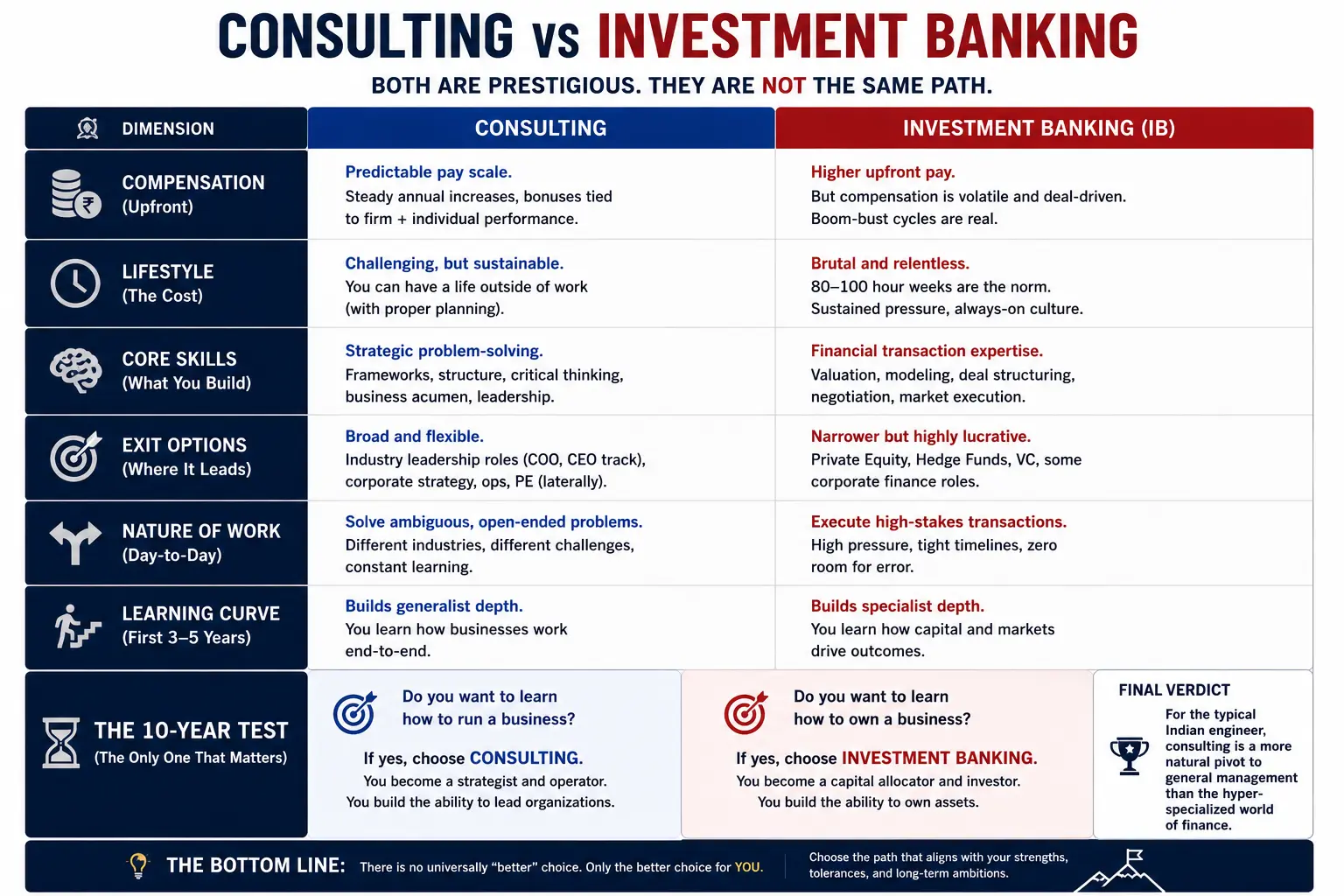
- Investment Banking (IB) pays more upfront, but the compensation is volatile and comes at a brutal lifestyle cost. Consulting pay scales more predictably.
- The core skills are fundamentally different. Consulting builds strategic problem-solvers. IB builds financial transaction experts.
- Consulting provides broad, flexible exit options into industry leadership (COO/CEO track). IB exits are narrower but highly lucrative (PE, Hedge Funds).
- The "10-Year Test" is the only one that matters. Ask yourself: do you want to learn how to run a business (Consulting) or how to own a business (IB)?
- For the typical Indian engineer, consulting is a more natural pivot to general management than the hyper-specialized world of finance.
Every year, hundreds of the brightest minds from India's best colleges—the IITs, the IIMs, SRCC—ask me the wrong question.
The question is: "Should I go into consulting or investment banking?"
This is the wrong question because it assumes they are comparable paths. They are not. It's like asking if you should become a surgeon or a Formula 1 driver. Both are elite, demanding, and high-paying. But they require different aptitudes, reward different temperaments, and lead to entirely different lives.
For nearly 15 years, I've sat on both sides of this fence. I've trained candidates who've landed coveted MBB offers, and I've guided others into front-office roles at Goldman Sachs and Morgan Stanley. I've seen the 24-year-old analyst's paycheck and the 34-year-old partner's stock options. I’ve also seen the burnout, the regrets, and the career pivots.
Let's dismantle this choice, piece by brutal piece. No fluff. Just the ground truth from thousands of data points.
The Money Myth: Your First Paycheck is a Head Fake
Let's get the money out of the way, because it's the most seductive and least important part of the decision.
Yes, in your first year out of an IIM or ISB, your friend at a bulge-bracket investment bank will likely make more than you at McKinsey, BCG, or Bain. In India, a top-tier consulting all-in package might be ₹30-40L. A front-office IB role could be ₹40-50L+, with the bonus being a significant, wild variable.
Your banker friend will post pictures from a trip you can't afford. Their bonus will be a number that makes your parents question your life choices. Get over it.
What you're missing is the structure of compensation and the trajectory.
- Volatility vs. Predictability: The IB bonus is a monster. It can be 100-200% of base salary in a good year. It can be zero in a bad one. Your life revolves around this single, massive payout. Consulting compensation is a smoother, more predictable escalator. The bonus is smaller, but your base salary climbs steadily and aggressively. You can plan your life. The banker is perpetually gambling on the market.
- The Golden Handcuffs: That massive IB bonus isn't just a reward; it's a retention tool. It creates "golden handcuffs." You stay for the next bonus, and then the next. Before you know it, five years have passed, your lifestyle has inflated to match your volatile income, and you're trapped. You can't leave, because no other industry will match last year's massive payout.
The consultant's path to wealth is slower but often more robust. They build wealth through steady, high-income accumulation and, later, through partner-level equity. The banker's path is a series of jackpots. Don't mistake the early jackpot for the long-term win.
Consulting sells 'how to think.' Investment Banking sells 'how to transact.' One builds strategic architects, the other builds financial engineers. Your choice isn't between two jobs; it's between two fundamental ways of creating value.
The Actual Job: PowerPoint Monkeys vs. Excel Grinders?
This is the most common, and most foolish, caricature of the two professions. It completely misses the point.
In consulting, the product is a recommendation. Your job is to enter a complex, ambiguous situation in an industry you might know nothing about, and within weeks, develop a perspective that is clearer, more structured, and more actionable than the CEO's. The tools are frameworks, data analysis, expert interviews, and relentless logic. The deliverable might be a slide deck, but the slide deck is just the container for the thinking. The thinking is the product.
I once had a candidate—a brilliant young lad, DTU Delhi engineer, 99th percentile CAT—who told me he was "great at making presentations." He was rejected from McKinsey in 15 minutes. Why? Because consulting isn't about *making* the slides. It's about having a thought process so rigorous that the slides are merely the inevitable, logical conclusion of your analysis.
In investment banking, the product is a closed deal. Your job is to facilitate a transaction—a merger, an acquisition, an IPO, a debt issuance. It is deeply quantitative. Your life is Excel. You build financial models with hundreds of tabs, perform valuations, and prepare marketing materials (the "pitch book"). It's about precision, stamina, and attention to detail at a level that would break most mortals. You might work 100 hours on a model only to have the deal fall apart. The emotional highs and lows are extreme.
The difference is breadth vs. depth. A consultant might work on a pricing strategy for a pharma company, a market entry for a tech firm, and a cost-cutting project for a manufacturer, all in one year. An M&A banker will only work on M&A deals, getting deeper and deeper into the mechanics of deal-making.
The 10-Year Test: Who Wins the War, Not the Battle?
This is the only question that matters. Forget the first salary. Forget the prestige. Project yourself ten years into the future. Where do these paths actually lead?
The Consultant's Exit Path: Optionality.
The skills of a consultant—structured problem solving, executive communication, managing stakeholders—are universally applicable. After 2-4 years at an MBB firm, the world opens up:
- Corporate Strategy: The classic exit. You become the internal consultant for a large company.
- P&L Ownership: This is the golden ticket. You move into a role where you run a business unit, a product line, or a region. This is the COO/CEO track.
- Product Management in Tech: Top tech firms love ex-consultants for their ability to synthesize market needs, user data, and business goals.
- Venture Capital / Private Equity (Operations): You join a fund not to source deals, but to help the portfolio companies run better.
- Entrepreneurship: You have a world-class toolkit for dissecting a market and building a business plan.
The consulting network is vast and diverse. Your former colleagues will be scattered across every industry imaginable.
The Banker's Exit Path: Specialization.
The skills of a banker are more specialized but incredibly valuable within the world of finance. The exits are narrower but extremely lucrative:
- Private Equity: The holy grail for most bankers. You move to the "buy-side," using the firm's money (and debt) to buy companies. This is where generational wealth is often made.
- Hedge Funds: Applying your analytical skills to public market investing.
- Venture Capital (Deal Side): Focusing on sourcing, evaluating, and executing investments in startups.
- Corporate Development: You become the internal M&A team for a large corporation, buying other companies.
The banking network is deep and powerful, but concentrated in the finance industry. Everyone you know is in finance.
The most common regret I hear from ex-bankers 10 years out: "I know how to value a company, but I don't know how to run one."
The most common regret from ex-consultants: "I wish I had the F-U money my banker friends made in their first five years."
The 'Desi' Dilemma: Special Considerations for the Indian Applicant
This decision has unique contours for students in India.
First, for the overcrowded profile of the Indian IT Male Engineer, consulting is a powerful and direct path to breaking the mold. It immediately repositions you as a business strategist, not a technologist. Investment banking can sometimes feel like a different flavor of intense quantitative work, just with finance instead of code.
Second, there is the social and family pressure. In many circles, the "investment banker" title carries a mystique and a perception of raw financial power that "consultant" doesn't. Your uncle might not understand what a consultant does, but he understands Goldman Sachs. You must be disciplined enough to ignore this.
Third, global mobility. Both paths offer it, but in different ways. A consultant might find themselves on a six-month project in Dubai or Singapore. A banker's transfer to London or New York is often a more permanent, firm-driven move tied to specific market needs. Both are incredible platforms for a global career post-MBA, but the nature of the work-life abroad will differ immensely.
So, we come back to the beginning. "Consulting or IB?" is the wrong question.
Here is the right one:
Do you want to learn how to RUN a business, or do you want to learn how to OWN a business?
This is an oversimplification, but it is the most useful one I've found in 20 years.
Consulting trains you to be an operator and a strategist. It teaches you how to improve efficiency, grow revenue, manage people, and structure organizations. It trains you to run things.
Investment banking trains you to be a capital allocator. It teaches you how to value assets, raise capital, and use finance as a tool to acquire and combine assets. It trains you to own things.
One path leads toward the C-suite. The other leads toward the cap table.
Both are valid. Both are admirable. But they are not the same. Stop asking which one pays more in year one. Start asking what kind of problem-solver you want to be when you're 40. That's the only question that will lead you to the right answer.
The choice between consulting and IB isn't a career choice; it's an identity choice. It defines the intellectual engine you'll build for the next 40 years.
If you're preparing for case interviews and want to cut through the noise with battle-tested strategies, follow me on LinkedIn (@AbhijeetDelhi) for more direct, unapologetic advice.