
TL;DR — Key Takeaways
- Most candidates fail predictably. It's not about intelligence; it's about flawed mental models that get exposed under pressure.
- The Framework Collector: Recites frameworks instead of thinking. They show they can memorize, not problem-solve. The antidote is first-principles thinking.
- The Human Calculator: Obsesses over math, misses the strategic insight. They answer the "what," but never the "so what?" The antidote is to prioritize business judgment over numerical precision.
- The Pleasant Pushover: Agrees with everything the interviewer says. They mistake this for being "coachable," but it signals a lack of conviction and leadership presence. The antidote is hypothesis-driven pushback.
Ninety-eight percent of applicants to McKinsey, BCG, and Bain get rejected. Everyone knows the odds are brutal. What they don't know is how shockingly predictable the failures are.
I've personally trained hundreds of candidates who made it. But more importantly, I’ve sat across from thousands in mock interviews and debriefed their real ones. I’ve seen the internal feedback forms. The reasons for rejection are not a mystery. They are a pattern.
It's not about brainpower. The candidates who get interviews are all smart. It's not about having a "consulting background." Some of the best hires come from poetry or particle physics.
The failure point is almost always a flawed mental model for what the case interview is actually testing. Candidates prepare for a test of knowledge, but they walk into a test of thinking. And under pressure, their preparation fails them.
After two decades of this, I can sort nearly every failed candidate into one of three archetypes. They are not mutually exclusive; some unlucky souls manage to be all three. If you see yourself in any of these descriptions, stop what you're doing. This is your wake-up call.
Archetype 1: The Framework Collector
He's confident. He's done 50 cases. He opens his crisp, new notebook, looks the interviewer dead in the eye, and says the words that sink his chances in the first 90 seconds:
“Thank you for that interesting prompt. To structure my approach for this market entry problem, I would like to use the 4Cs framework: Company, Customers, Competitors, and Costs.”
The interviewer’s face doesn't change, but internally, they've just downgraded him by 20%. The candidate then proceeds to robotically walk through each bucket. "For Customers, I'd like to understand segmentation, needs, and price sensitivity." It’s a flawless recitation from a case prep book.
And it is completely, utterly useless.
Why It Fails
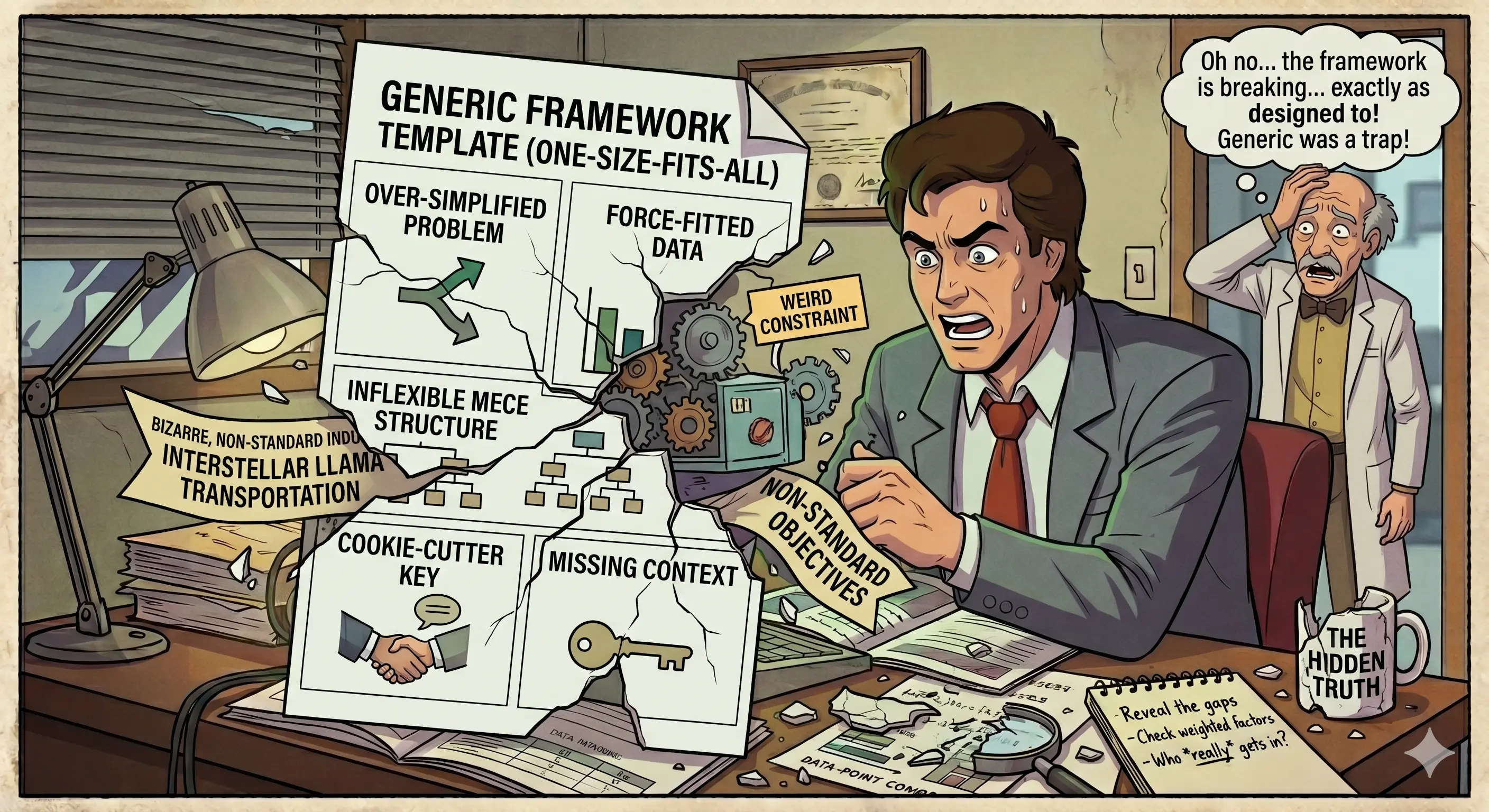
MBB cases are not designed to fit neatly into a pre-packaged framework. In fact, they are often designed to specifically break them. They will have a weird constraint, a bizarre industry, or a non-standard objective. Using a generic framework isn't just uncreative; it's actively counterproductive. It shows the interviewer three terrible things:
- You can't handle ambiguity. You need a safety blanket to start thinking. Real client problems are messy and never come with a pre-labeled framework.
- You are not listening. The most important clues are in the prompt. The Framework Collector ignores them in his rush to apply his memorized structure.
- You are not a first-principles thinker. This is the cardinal sin. Consultants are paid to create bespoke solutions, not apply generic templates. They deconstruct a problem into its unique, logical components. They build the structure, they don't borrow it.
The Antidote: Think from First Principles
Scrap the named frameworks. Instead, build an "issue tree." Start with the core question (e.g., "How can we double the client's profit in the next 3 years?"). Then, break it down into its most basic, logical, and mutually exclusive components.
Profit = Revenue - Costs. That’s your first level. Simple. Unbreakable.
Then break that down. Revenue = Price x Volume. Costs = Fixed Costs + Variable Costs. That's your second level.
Now, keep going, but get specific to the case. What drives volume for *this* client? Is it number of stores x sales per store? Or number of users x purchase frequency x basket size? The details of the case prompt tell you which path to take.
This approach forces you to be hypothesis-driven from the start. You're not just "exploring" a bucket called "Competitors." You're asking a sharp question: "My hypothesis is that our declining volume is due to a new competitor stealing market share. To test this, I need to understand their pricing and product features relative to ours."
This is what an MBB partner does. Do that.
Archetype 2: The Human Calculator
She's brilliant. Probably a quant or engineer. Halfway through the case, the interviewer asks her to estimate the size of the market for artisanal dog food in London.
Her eyes light up. This is her comfort zone. She starts, "Okay, population of London is about 9 million. Let's assume households, say 2.5 people per household, so that's 3.6 million households. Now, dog ownership rates in urban areas... let's say 25%..."
Five minutes later, she has a number. "The market size is approximately £47.82 million." She delivers the number with precision and pride. She nailed the math.
The interviewer nods slowly and says, "Okay. So what?"
And she's completely stuck. Her entire focus was on getting the number right, not on what the number *means*. She won the battle of the calculation but lost the war of the case.
Why It Fails
The math in a case interview is a test of business judgment, not a test of arithmetic. The interviewer cares about your logic, your assumptions, and your ability to interpret the result, not your ability to do long division to two decimal places.
The Human Calculator makes several critical errors:
- False Precision: Giving a number like "£47.82 million" on a back-of-the-envelope estimate is a red flag. It shows you don't understand the nature of estimation. A top candidate would say, "It's in the ballpark of £50 million."
- No Sanity Check: After getting the number, they don't pause to ask, "Does this make sense?" Is £50 million a huge market or a tiny one? How does it compare to, say, the market for regular dog food?
- The "So What?" Deficit: This is the killer. The calculation is a tool to advance the case. The output of the math must be an input to a decision. Is this market big enough to enter? Does this cost-saving initiative move the needle enough to be worth it? Without this step, the math is a pointless academic exercise.
A partner at BCG once told me, "I can hire an army of analysts in our shared service centers to run the numbers perfectly. I hire consultants to stand in front of a CEO and tell her what the numbers mean for her business, and what she should do on Monday."
The Antidote: The 80/20 Rule of Case Math
Your goal is to be 80% correct on the math and 100% correct on the implication. Not the other way around.
Round Aggressively and State It: "The population is 9 million. For this estimation, I'm going to round that to 10 million to keep the numbers simple, and we can refine it later if needed." This shows confidence and a focus on what matters.
Structure First: Before you write a single number, lay out your entire equation in words. "Okay, to get the market size, I'm going to calculate (Number of Households) x (Dog Ownership Rate) x (Annual Spend on Artisanal Food per Dog)." This lets the interviewer follow your logic, even if you make a small math error later.
Always State the "So What": This is non-negotiable. After every single calculation, no matter how small, you must complete the sentence: "The number is X, and what this tells me is..."
Example: "The number is approximately £50 million. What this tells me is that while it's not a massive market, it could be a highly profitable niche for our client, who specializes in premium products. My next question would be to understand the growth rate of this niche."
That's the move of a consultant, not a calculator.
Archetype 3: The Pleasant Pushover
This is the most heartbreaking failure, because the candidate is often smart, prepared, and incredibly likable. He builds great rapport. He smiles. He's polite. He's everything his mother would want in a son-in-law.
And it's killing his candidacy.
He'll present his structure. The interviewer, testing him, will gently interject: "That seems reasonable, but have you considered the regulatory angle?"
The Pushover's immediate reaction is to fold. "Oh! You're absolutely right! An excellent point. My apologies, I should have included that. Let me add a 'Regulatory' bucket to my framework."
He thinks he's being coachable. He thinks he's showing deference and respect. What the interviewer sees is a complete lack of intellectual ownership and spine. They see someone who will be eaten alive by a difficult client or a challenging senior partner.
Why It Fails
Consulting is not a passive profession. Clients hire you to have a point of view, to challenge their assumptions, and to drive to an answer with conviction. The interview is a simulation of that dynamic. An interviewer's pushback is not a criticism; it's a test. They are testing your "presence."
The Pleasant Pushover fails this test spectacularly by demonstrating:
- Lack of Conviction: If you abandon your structure at the first sign of a challenge, how strongly did you believe in it in the first place? It suggests your structure was weak or you don't have the confidence to defend your own logic.
- Misunderstanding "Coachability": Coachability is not about instantly agreeing with everything a senior person says. It's about hearing new information, processing it, and integrating it into your thinking in a structured way, without losing your own point of view.
- A Follower Mindset: Consultants are expected to lead. They lead meetings, they lead workstreams, they lead clients to a conclusion. Passively waiting for the interviewer to guide you is the opposite of leadership.
The Antidote: Develop Hypothesis-Driven Conviction
You must have a backbone. But it must be a backbone supported by logic and data, not by ego.
When an interviewer challenges you, do not fold. Do not argue either. Engage.
Use this magic phrase: "That's a great point. My current hypothesis is X, based on my initial structuring of the problem. Your question about regulation makes me think there might be a risk I haven't considered. Could I take a moment to think about how that impacts my approach?"
Let's break down why this works:
- You acknowledge the input: "That's a great point." (Polite, respectful).
- You re-state your position and its basis: "My current hypothesis is X..." (Shows you have a logical point of view).
- You incorporate their challenge as a potential risk/opportunity to your hypothesis: "...your question makes me think..." (Shows you are listening and thinking).
- You maintain control and propose a path forward: "Could I take a moment..." (You are driving the case, not being driven).
This transforms you from a passive recipient of feedback into an active thought partner. This is the single biggest differentiator between a "strong" candidate and a "hire." It’s the difference between being pleasant and having presence.
These three archetypes are not caricatures. They are composites of real, smart, ambitious people I have seen fail year after year. They fail because they prepare for the wrong test. They study the "what" of case interviews—the frameworks, the market sizing formulas—but they never master the "how" of consultant-level thinking.
Don't be one of them. Burn the framework flashcards. Reframe math as a tool for insight. And the next time someone challenges you in a mock interview, don't fold. Stand your ground, logically. That's where the real learning begins.
If you recognized a piece of yourself in the Framework Collector, the Human Calculator, or the Pleasant Pushover, good. Awareness is the first step.
The second is taking action. What’s the single biggest habit you're going to break in your very next mock case?