
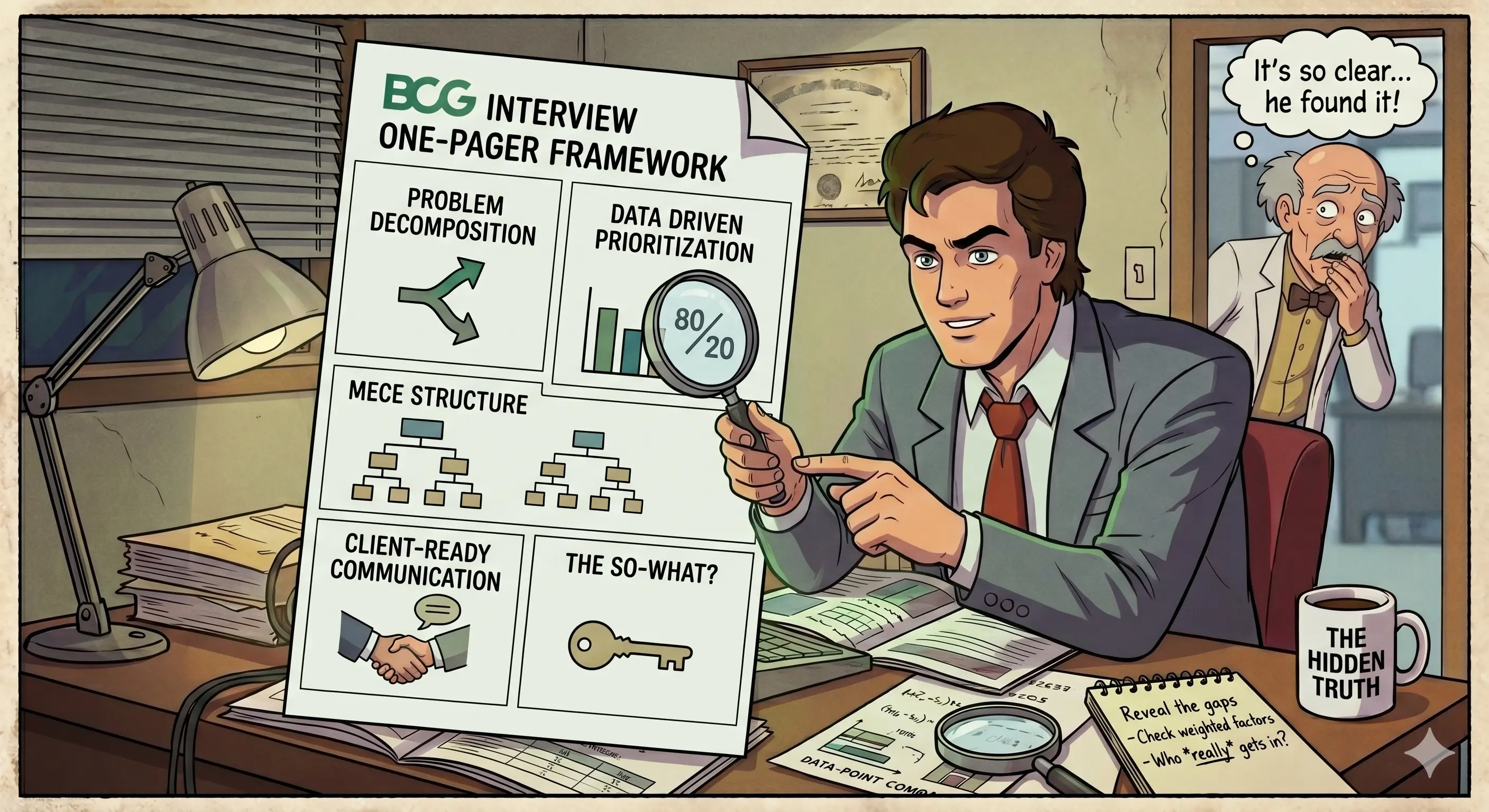
Your profitability framework is why you're getting rejected from BCG.
Let me say that again. That neat little tree diagram — Profit = Revenue - Costs — the one you diligently memorized from every case book and YouTube video, is actively harming your chances.
I've spent twenty years sitting on both sides of the interview table. I've trained hundreds of candidates who now have "Consultant at McKinsey/BCG/Bain" on their LinkedIn profiles. And I’ve sat in the post-interview debriefs where partners decide a candidate’s fate in under 60 seconds.
The conversation is never, "He didn't know the 4Ps." It's always a variation of, "She was unstructured." Or, "He was too generic." Or, "Couldn't get to the 'so what'."
All of these are code for one simple thing: the candidate regurgitated a framework instead of thinking from first principles. They showed us a textbook diagram, not a plan. This is especially lethal in a BCG interview, where the emphasis on customized, hypothesis-driven thinking is an obsession.
The Myth of the "Correct" Framework
The entire cottage industry of case prep has sold you a lie. The lie is that for every case type, there is a corresponding framework you must apply. Profitability case? Use the Profitability Framework. Market entry? Use the Market Entry Framework. M&A? You get the idea.
This is Level 1 thinking. It’s what gets average candidates from average schools into average firms. It will not get you into MBB.
Why? Because a framework is a classification system. It tells you the parts of a thing. A car has an engine, a chassis, wheels. A company's profit has revenue and cost components. Congratulations, you’ve passed Business 101. But a consultant isn't paid to classify. A consultant is paid to solve.
I remember a candidate I was coaching years ago. Brilliant IIT/IIM pedigree, 770 GMAT, flawless resume. He walked into his final round BCG interview. The prompt was a complex pricing case. He started with, "The framework I'd like to use to structure my thoughts has three main buckets: Company, Competitors, and Customers..." I saw the Partner physically lean back. His eyes glazed over. The candidate was technically correct, but he was dead on arrival. He showed he could categorize, not that he could diagnose and solve.
Your interviewer isn't testing if you remember the 3Cs. They are simulating a real client interaction. No consultant walks into a CEO's office and says, "To solve your multi-billion dollar supply chain crisis, let's start by discussing your Company, your Competitors, and your Customers." You'd be fired on the spot. You walk in and say, "We believe the issue is in your last-mile logistics, specifically with your inventory management in Tier 2 cities. Here's how we're going to prove it and what we'll analyze to fix it."
That is the difference. And that is what they want to see in the first five minutes of your case.
Consultants don't get paid to show frameworks. They get paid for structured answers. Your interview structure must reflect the answer, not just the problem.
What BCG *Actually* Wants: The Answer-First Slide
So if generic frameworks are out, what's in? The "one-pager," the "slide-based structure," the "answer-first approach." It goes by many names, but the concept is singular and powerful.
You must structure the problem as if you are presenting the final recommendation slide to the client.
This single mental shift separates the top 1% of candidates from everyone else. Instead of breaking down the problem into its parts, you're outlining the logical argument you will build to arrive at a solution. Your structure becomes a work plan, a series of questions that, once answered, will definitively solve the case.
A great one-pager structure has three core components:
- The Overarching Hypothesis: This is the headline of your slide. It's a clear, testable, "answer-first" statement. It's not, "Let's look at profits." It is, "I hypothesize that we can restore profitability not by cutting costs, but by segmenting our customer base and optimizing our pricing for the top 20% of high-value customers."
- MECE Buckets as Key Questions: Your buckets are not generic labels like "Revenue" and "Cost." They are the 3-4 critical questions you must answer to prove or disprove your hypothesis. They must be Mutually Exclusive and Collectively Exhaustive (MECE) in the context of your hypothesis.
- Sub-bullets as Specific Analyses: Under each key question, you list the specific analyses or data points you need. This shows the interviewer you not only know *what* to look at, but *how* you will look at it.
This is no longer a passive description of the problem. This is an active, aggressive plan to dismantle it.
From Bad Framework to BCG-Ready Structure: A Concrete Example
Let's make this real. Here's a classic prompt:
"Our client is 'BrewCo,' a large European beer manufacturer. Their flagship lager, 'Nordic Light,' has seen its profits decline by 15% in the last year, despite sales volume remaining flat. The CEO wants to know why, and what to do about it."
The Average Candidate's (Bad) Structure:
"Okay, this is a profitability problem. I'll use the profitability framework."
- Profit = Revenue - Cost
- Revenue = Price x Volume (Since volume is flat, we should look at Price)
- Cost = Fixed Costs + Variable Costs
- Variable Costs: Raw materials, packaging, distribution.
- Fixed Costs: Factory overhead, marketing, salaries.
Why this fails: This is a dictionary definition. It shows zero business acumen. It's not tailored to a beer company. It's not hypothesis-driven. You've told the interviewer nothing they don't already know. You've simply stated that profit has two components. This is a massive missed opportunity to impress.
The Top 1% Candidate's (BCG-Ready) Structure:
"Okay, thank you for the prompt. This is a critical issue for BrewCo. My initial hypothesis is that since volumes are flat, the 15% profit decline is being driven primarily by a shift in our channel or product mix towards lower-margin segments, and/or a significant increase in a specific input cost like aluminum or hops.
To test this hypothesis, I'd like to structure my analysis into three key areas:
- First, I want to diagnose the exact driver of the margin erosion.
- Has our net effective price per liter decreased? This could be due to a higher proportion of sales through low-margin channels like large discount supermarkets vs. high-margin channels like bars and restaurants. I'd want to see revenue and margin data broken down by channel.
- Has our product mix shifted? Are consumers buying more 12-packs (lower margin) and fewer single bottles (higher margin)? I'd need to see the sales mix and margin per SKU.
- On the cost side, has a specific component of our COGS (Cost of Goods Sold) spiked? I'd want to analyze the per-liter cost of raw materials (barley, hops), packaging (aluminum cans vs. glass bottles), and logistics over the last 18 months.
- Second, assuming we identify the root cause, I want to evaluate potential levers to restore profitability.
- If it's a channel mix issue, what are our options? Can we incentivize sales through high-margin channels with targeted promotions or sales force efforts? What's the feasibility and ROI of this?
- If it's a cost issue (e.g., aluminum), can we hedge prices, find alternative suppliers, or engage in lightweighting the can? What would be the cost and timeline for these initiatives?
- We could also explore a price increase, but we must first understand the price elasticity of Nordic Light and the potential competitive reaction.
- Third, I want to assess the risks and implementation considerations for any proposed solution.
- For example, if we push sales towards bars, do we risk alienating our key supermarket partners?
- What are the key financial and operational metrics we should track to ensure the turnaround is successful?
Why this wins: See the difference? It's night and day. This structure is a surgical tool, not a blunt instrument. It's tailored (mentioning channels, aluminum, hops). It's hypothesis-driven. It's action-oriented (diagnose, evaluate, assess). It tells the interviewer that you are thinking like a partner, not an analyst. You’ve laid out a complete project plan in three minutes.
A good candidate structures the problem. A great candidate structures the path to the answer.
How You Can Develop This Skill
This level of thinking doesn't come from memorizing more frameworks. It comes from changing how you think. It's a skill you must build through deliberate practice.
- Burn Your Framework Flashcards. Seriously. The first step is to unlearn your bad habits. Stop reaching for a pre-canned solution.
- Embrace First Principles. The only things you need to remember are concepts, not diagrams. Understand MECE. Understand hypothesis-driven problem solving. That's it. Everything else should be built from scratch, for the specific problem at hand.
- Read Business News Like a Consultant. When you read an article in the Wall Street Journal about a company's struggles, pause. Ask yourself: "If I were the consultant hired to fix this, what would my one-pager 'answer-first' slide look like? What is my initial hypothesis? What are the 3-4 key questions I need to answer to prove it?" Do this every day. It's the most valuable case prep you can do.
- Whiteboard Everything. Don't just think it, draw it. Get a small whiteboard. When you practice a case, stand up. Draw the boxes for your key questions. List the analyses underneath. The physical act of structuring your thoughts visually forces clarity and logic. It's what we do on the job.
- Demand More From Your Mock Interviews. Don't let your practice partners get away with giving you feedback like "Good structure." Ask them, "Was it just a good classification, or was it a real plan? Did it have a strong hypothesis? Was it tailored? Did it tell you exactly what I was going to do next?"
This is harder. It requires more mental energy than simply pulling a framework from memory. That's the point. The interview is designed to test your ability to do this hard mental work under pressure. The candidates who can, get the offers. The ones who can't, get the polite email a week later.