
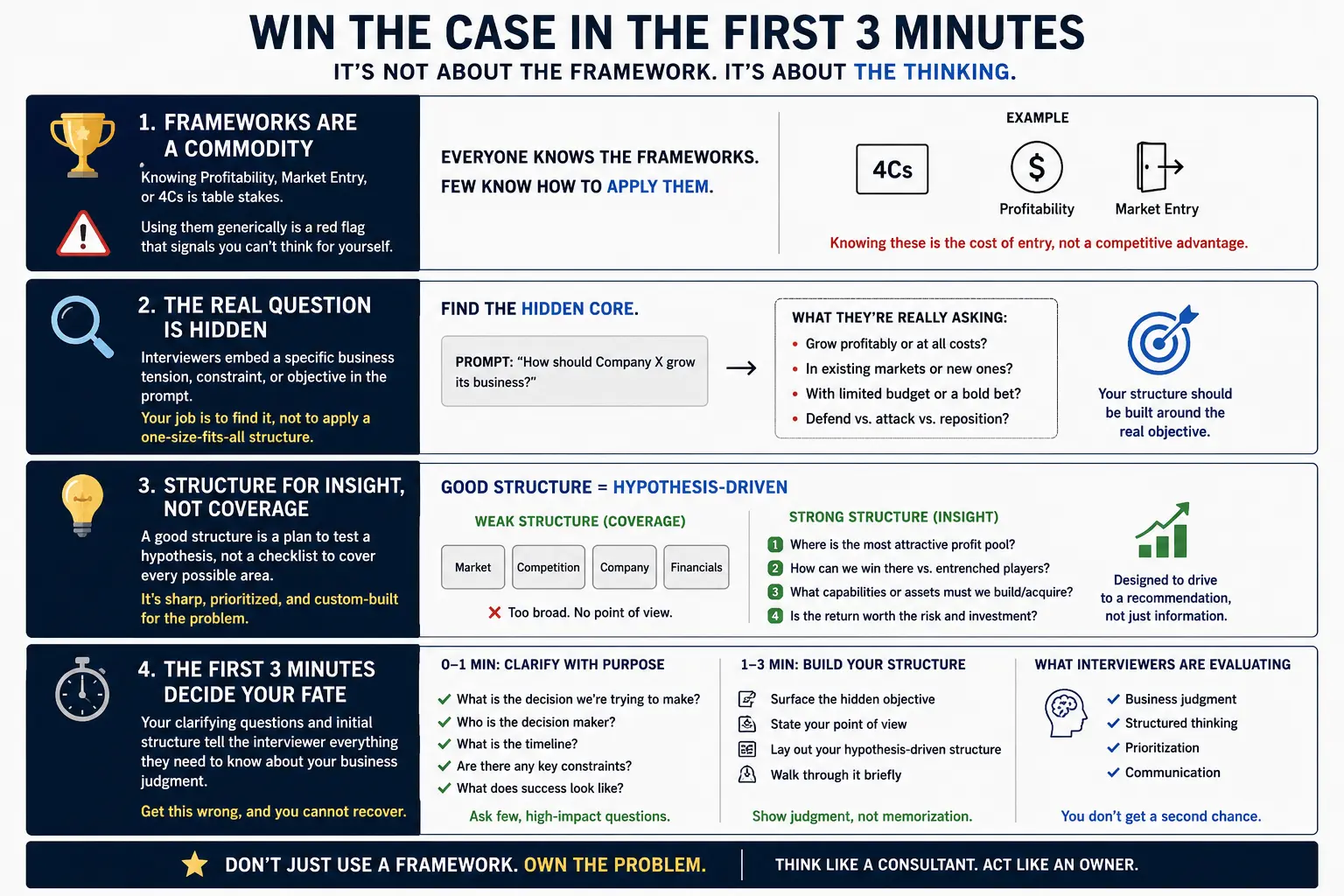
TL;DR — Key Takeaways
- Frameworks are a commodity. Knowing Profitability, Market Entry, or 4Cs is table stakes. Using them generically is a red flag that signals you can't think for yourself.
- The real question is hidden. Interviewers embed a specific business tension, constraint, or objective in the prompt. Your job is to find it, not to apply a one-size-fits-all structure.
- Structure for insight, not coverage. A good structure is a plan to test a hypothesis, not a checklist to cover every possible area. It's sharp, prioritized, and custom-built for the problem.
- Generic "buckets" are lazy. "Market," "Competition," "Company" are categories, not questions. Your structure must be composed of specific questions you need to answer.
- The first 3 minutes decide your fate. Your clarifying questions and initial structure tell the interviewer everything they need to know about your business judgment. Get this wrong, and you cannot recover.
I’ve sat in thousands of mock interviews. I’ve read the internal feedback from MBB partners on candidates they rejected. And I can tell you with absolute certainty:
90% of consulting rejections are decided in the first five minutes.
It’s not when you fumble a calculation. It’s not when you can’t brainstorm 15 creative ideas. It’s right at the beginning. It’s silent. You don’t even know it’s happening.
It’s the moment you hear the prompt and say, “Great. To structure this problem, I will look at…” and then proceed to recite a framework you learned from a book.
In that instant, you have failed. You have shown the interviewer you are a student, not a consultant. A memorizer, not a thinker.
Let me be blunt. Your mastery of standard frameworks is not impressive. It’s the bare minimum. It’s like a chef knowing how to hold a knife. The real work hasn't even begun.
The Framework Illusion: Why Your Crutch is Crippling You
Candidates spend hundreds of hours memorizing frameworks. Profitability. Market Entry. M&A. 3Cs, 4Ps, 7Ss. They build mental libraries, ready to deploy the "right" one at a moment's notice.
This is the biggest trap in case prep.
Frameworks are a crutch. They provide a false sense of security. They make you feel like you have a plan, when all you have is a generic template. The interviewer isn't testing your ability to recall a template. They are testing your ability to think through a unique, messy, specific business problem and create a logical path to a solution.
I once coached a candidate from a top-tier engineering school. Brilliant, quantitatively sharp, flawless resume. He could recite every framework backward. In a mock case, the prompt was: "Our client is a global private equity firm. They are considering acquiring a popular Indian restaurant chain that is highly profitable in its home city but has no other locations. Should they do it?"
He immediately said, "Okay, this is an M&A case. I'll structure it into three parts: 1. Standalone value of the target, 2. Synergies, and 3. Risks."
He was technically correct. But he was completely, utterly wrong.
He missed the entire point. The real question wasn't about a standard M&A valuation. The *real question*, the client's core anxiety, was: "Is this brand's magic scalable, or is it tied to one city, one founder, one specific culture?" The entire case hinged on growth potential, not on current valuation. His generic structure completely ignored this central tension. He failed before he even started the analysis.
A framework is a map of a generic city. Your case prompt is a specific address in a real city. Using the generic map won't get you to the exact door. You need to read the street signs.
Deconstructing the Prompt: The Art of the First 60 Seconds
Top candidates don't just listen to the prompt; they dissect it. They hunt for the nuances, the constraints, the adjectives that betray the client's true objective.
Let's take a common prompt and see how most candidates vs. top candidates handle it.
Prompt: "Our client is a major German luxury automaker, known for its high-performance sedans. They're seeing Tesla and others gain traction in India's nascent EV market. They want our help to decide if they should enter the Indian EV market, and if so, how."
The Average Candidate's Approach (The Template Follower):
They hear "enter the market" and their brain lights up: MARKET ENTRY FRAMEWORK!
Their clarifying questions are generic:
- "What is the client's revenue?" (Probably irrelevant)
- "Have they entered other markets before?" (Maybe, but not the core issue)
- "Can I take a moment to structure my thoughts?" (Wasted question)
Their structure is a carbon copy of the textbook:
- Market Analysis: What is the size and growth rate of the Indian EV market?
- Competition: Who are the key players? What is their market share?
- Company Capabilities: Do we have the technology and brand to compete?
- Entry Strategy: Should we build, buy, or partner?
This is not wrong. It's just useless. It's a C- grade answer. It shows zero independent thought. You could apply this structure to a coffee shop entering a new neighborhood. The interviewer is bored, and you've already been mentally bucketed with the other 90%.
The Top 2% Candidate's Approach (The Problem Solver):
They hear the *whole* prompt. They latch onto the critical words: "German luxury automaker," "high-performance," "India's nascent EV market." They immediately sense the tension: high-end luxury brand vs. a price-sensitive, infrastructure-poor market.
Their clarifying questions are sharp and strategic:
- "You mentioned 'luxury' and 'high-performance.' Is the client's objective to maintain this premium positioning at all costs, or are they willing to consider a more mass-market vehicle to gain volume?"
- "What is the client's time horizon for profitability? Are they willing to invest for 10 years to build the market, or do they need a positive ROI in 3-5 years?"
- "When we say 'enter the market,' does this have to be through local manufacturing, or are we open to considering import-only models initially?"
See the difference? These questions aren't about filling in blanks in a framework. They are about defining the boundaries of the problem and understanding the client's definition of success.
Stop using "buckets." Start asking "questions." Your structure should not be a list of topics like "Competition." It should be a list of questions you must answer, like "Can we realistically compete with local players on price, or must we win on brand and technology alone?"
Structuring for Insight: Building a Custom Hypothesis
Armed with answers to their clarifying questions, the top candidate now builds a custom, hypothesis-driven structure. They don't list topics; they lay out a logical path to prove or disprove a central hypothesis.
Let’s say the answer to the clarifying questions was: "The client must maintain its premium brand image and is looking for a 5-year ROI."
The candidate forms a sharp, testable hypothesis:
"My initial hypothesis is that the client should enter the Indian EV market, but not by competing with the mass-market. Instead, they should target an ultra-premium niche (>₹1 Crore) with a limited, import-only (CBU) model to test the market, build brand, and avoid massive upfront capital expenditure."
This is a game-changer. It shows the interviewer you have business judgment. Now, the structure isn't a checklist; it's a plan to test this specific hypothesis.
The Top 2% Candidate's Structure:
-
Is the "Ultra-Premium" EV Niche Viable?
- First, let's quantify the true addressable market: How many households in India can afford a >₹1 Crore EV? What is their current luxury vehicle ownership?
- Second, what is the unit profitability? Model the price, import duties, and margins to see if a low-volume model can meet the 5-year ROI target.
-
Can We Win This Specific Niche?
- Who are our direct competitors in *this* price bracket (e.g., Porsche Taycan, high-end Tesla imports), not the entire EV market?
- How strong is our brand equity in India specifically for cutting-edge technology vs. just traditional luxury? Will buyers trust our first-gen EV?
-
Is the Import-Only (CBU) Model the Right Path?
- Let's analyze the critical risks of this model: What are the regulatory hurdles for CBU imports? How do we solve the charging infrastructure problem for this select client base?
- Compare the financial model (breakeven, risk profile) of a CBU entry vs. a high-capex local assembly plant to validate our choice.
Look at this structure. It's specific. It's prioritized. It's a series of questions that flow logically. It directly addresses the client's constraints (premium brand, ROI horizon). It's designed to deliver an answer, not just to "explore the market."
This is what gets you hired. This is thinking like a consultant.
The tyranny of MECE (Mutually Exclusive, Collectively Exhaustive) is another trap. Yes, your structure should be logical and comprehensive. But I would rather see a candidate present a brilliantly insightful, hypothesis-driven structure that is 95% MECE than a perfectly MECE structure that is generic and uninspired. Don't let the pursuit of perfect categorization paralyze your ability to prioritize the most important issues. A sharp spike is better than a flat circle.
Your Structure is Your First Deliverable
In consulting, you don't have months to figure things out. A partner will walk into your team room and ask, "What's the answer?" You need to have a structured plan of attack. That's what the case interview is simulating.
Your structure is not just a plan for the next 20 minutes of the interview. It is a demonstration of your entire professional capability:
- Do you listen? Or do you just wait for your turn to speak?
- Can you prioritize? Or do you treat every piece of information as equally important?
- Can you handle ambiguity? Or do you need a pre-baked recipe to function?
- Do you have business judgment? Or are you just an academic who is good at exams?
Stop practicing frameworks. Start practicing thinking. Take any business news headline and give yourself 90 seconds to ask clarifying questions and two minutes to build a hypothesis-driven structure. Do this over and over. Deconstruct prompts. Identify the hidden question.
The path to an MBB offer isn't paved with more frameworks. It's paved with the brutal, repeated practice of custom problem-solving. Your brain, not your notebook, is the ultimate framework.
The difference between an offer and a rejection is not knowledge. It is judgment. Your case structure is the first, and most important, display of that judgment.
Stop being a template follower. Start being a problem solver.
Share this with one person who is stuck in the framework trap. It might be the most valuable case prep advice they ever get.